
Epoxy Garage Flooring in North County San Diego
A bonded epoxy coating turns a stained, dusty concrete slab into a bright floor you can sweep and mop. We install epoxy garage floors for homeowners in Oceanside and across North County San Diego.
Bare concrete sheds dust, soaks up oil and shows every drip. An epoxy coating seals that surface under a hard, glossy layer, so the garage stays cleaner and feels like part of the house. How long a coating lasts is mostly decided before the first coat goes down: we clean and prepare the concrete so the epoxy bonds to the slab instead of sitting on top of it. If you'd like a quote, we come to your garage, look at the concrete and talk through colors and finishes with you. The estimate is free.
- 15 Year Warranty
- Fast Installation
- Licensed & Insured
- Free Consultation
- 5.0 on Google · 15 reviews
What’s included
- The concrete is cleaned and prepared first, so the coating bonds to the slab
- A primer coat goes down before the epoxy for a secure bond
- Solid colors, flake blends or a metallic finish
- Textured options for more grip where the floor gets wet
- An in-person estimate at your garage
At a glance
Durability
- Our seamless, high-gloss coatings resist damage, boost brightness, and are built to handle everything from oil spills to heavy vehicles.
- Highly Durable Resists stains, cracks, abrasions, and chemical spills for years of reliable performance.
- A high-grade primer creates a secure bond between the concrete and epoxy layers.
Lifespan
- Professional epoxy flooring installation that resists wear, reflects light, and enhances your garage's look for 10+ years.
- Lasts 10–15 Years or More With proper care, epoxy coatings retain their shine and strength for over a decade.
Upkeep
- Low Maintenance Epoxy floors are easy to clean—just sweep and mop with mild detergent. No sealing required.
- Cleaner Than Concrete Epoxy doesn’t trap dust or soak up oil, making your garage cleaner and healthier.
Value
- Boosts Home Appeal Epoxy adds visual polish and value to your home—like a showroom right in your garage.
What an epoxy garage floor is
Epoxy is a two-part resin. The two parts are mixed on site and applied to the floor, where they react and cure into a hard, continuous surface with no grout lines or seams to collect dirt. On a garage floor it is applied over a primer and can be finished in a solid color, with decorative flakes broadcast into it, or with metallic pigments for a one-of-a-kind look.
It is worth knowing how a professional system differs from the garage floor paint sold in hardware stores. Many store kits are thin coatings rolled onto concrete that has been cleaned and acid-etched rather than ground, and they tend to lift where tires sit and turn. A professional installation starts with mechanical preparation of the slab, uses a primer to lock the system to the concrete, and builds the coating up in more than one layer.
That preparation step is the one we don't rush. If a slab has cracks, an old coating or oil soaked into it, we deal with that before anything else goes down, because a coating is only as good as its bond.
What changes with an epoxy floor
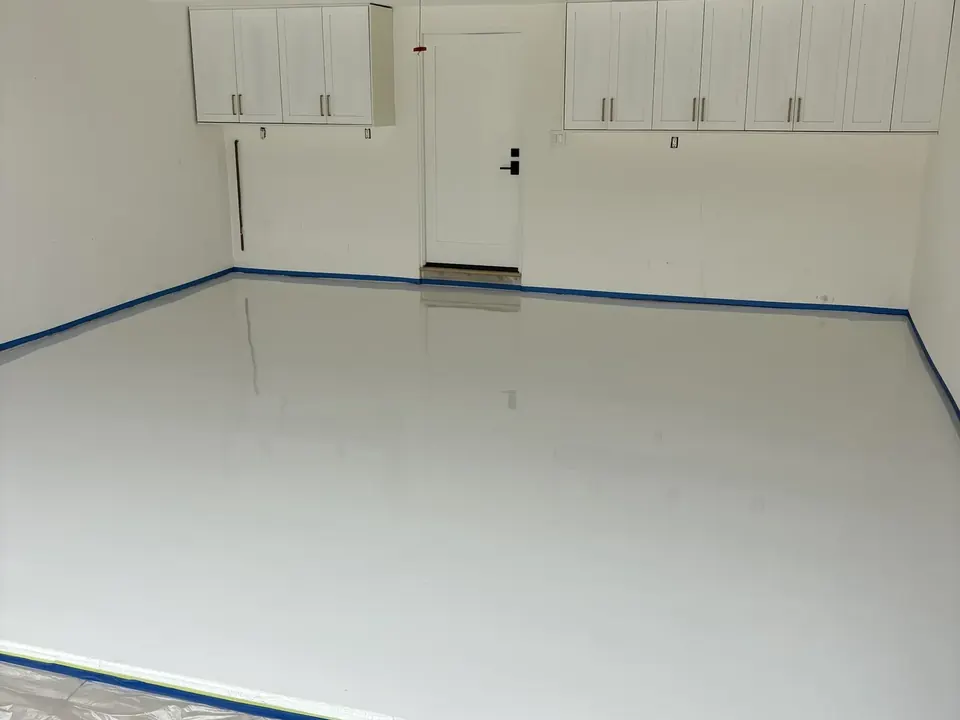
A glossy epoxy floor reflects light back into the room, so a garage that felt dim and gray looks brighter, bigger and more finished.
Concrete is porous, so oil, paint and road grime soak in and stay. An epoxy floor is sealed: spills sit on top where you can wipe them up, and a sweep and a mop with mild detergent keeps it looking right, with no waxing or resealing.
Epoxy also resists stains, abrasion and the chemical spills that come with cars and projects, and it stops the fine dust that bare concrete keeps shedding onto everything you store.
The look is up to you: a solid color for a clean, simple garage, a flake blend that hides dust and adds texture, or a metallic finish that turns the floor into a feature. If the floor will get wet, we can add a textured finish for extra grip.
From estimate to finished floor
- 1 Surface Preparation
- 2 Primer Application
- 3 Epoxy Coating
- 4 Final Inspection & Cure
It starts with a visit. We look at the concrete, note any cracks or old coatings, assess the space and talk through the finish you want. You'll get a clear quote for your garage.
Before installation day, the garage needs to be empty so we can work on the whole slab. We begin with surface preparation: the concrete is cleaned and mechanically prepared so the primer can grip it, and any repairs happen at this stage. Next comes the primer, then the epoxy coats in the color and finish you picked.
When the last coat is down, we do a final inspection with you. The floor then needs time to cure before you walk on it and longer before you park on it; we'll tell you exactly when it's ready for your floor and your conditions, and what to do to keep it looking new.
Questions & Answers
Is epoxy the same as the garage floor paint sold at hardware stores?
No. Many store kits are thin coatings rolled onto concrete that has been cleaned and acid-etched rather than ground. We prepare the slab mechanically, prime it, and build the epoxy up in more than one layer, which is what keeps it bonded where tires sit and turn.
How do I clean an epoxy garage floor?
Sweep it, then mop with water and a mild detergent. Because the surface is sealed, spills stay on top and wipe up. It doesn't need waxing or resealing.
Can you coat a floor that already has cracks or an old coating?
Usually, yes. Cracks and failing coatings are dealt with during surface preparation. We look at your slab at the estimate and tell you what it needs before you commit to anything.
Should I choose epoxy or polyaspartic?
Both make a durable garage floor. Polyaspartic cures faster and resists yellowing in sunlight, which suits a garage that sits open to the sun; epoxy is a proven, cost-effective base for color, flake and metallic finishes. We'll recommend one for your garage at the estimate.
More answers on our garage floor and storage FAQ.
Glossary
- Two-part epoxy
- A resin and a hardener mixed on site; they react and cure into a hard coating.
- Surface preparation
- Cleaning and mechanically preparing the concrete so the coating can bond to it.
- Primer
- The first coat, which locks the system to the concrete.
- Topcoat
- A clear final layer that protects the color or flakes underneath.
- Hot-tire pickup
- When warm tires pull a poorly bonded coating off the floor — the failure good preparation prevents.
Related services
Flake Systems
A flake floor has decorative vinyl flakes broadcast into a base coat and sealed under a clear topcoat.
Polyaspartic Coatings
Polyaspartic is a fast-curing coating from the polyurea family.
Metallic Finishes
Metallic epoxy uses special pigments that are worked into the coating while it's wet, so the finished floor has depth and movement, and no two floors are alike.
Get a free epoxy floor estimate
Call or text (760) 712-6561, or send us a message, and we'll set up a time to look at your garage.